"In the tradition of Gabrielle Zevin’s Tomorrow, and Tomorrow, and Tomorrow, Meg Charlton’s Voyagers is a finely written and propulsive novel about the enduring power of friendship. It takes on big issues: the reliability of memory, the price of childhood fame, the ways adults use children for their own purposes. It’s also a book about aliens, geared for terrestrials. Which is to say it’s complex and human, anchored by a beating heart.”—Joshua Henkin
When the Signal—a mysterious transmission pulsing from the edge of the solar system— arrives, the world changes overnight. Planes are grounded, satellites fail, and speculation abounds. With many believing this could be first contact with extraterrestrial life, humanity holds its breath. But for Alex, a thirtysomething lawyer who’s spent years distancing himself from the unexplainable, the Signal feels deeply personal—the opening of an old wound.
Decades ago, Alex and a girl named Ana both vanished for thirty-six hours while on vacation near Palm Springs. When they returned, dazed but unharmed, the six-year-olds’ account of their experience had all the hallmarks of an alien abduction. The media frenzy that followed made them famous, and the long months of child stardom, of talk shows and sitcom cameos, forged a seemingly unbreakable bond between them—until the mystery behind their disappearance began to tear them apart.
Now, with the world on edge and the Signal growing stronger, Alex is drawn back to the one person who might have answers. Ana—now a professional advocate for experiencers of extraterrestrial contact—is leading a retreat near Palm Springs, a stone’s throw from the site of their childhood disappearance. As the former best friends tentatively reunite, what starts as a quest to confront the reality of their original experience becomes a larger reckoning with friendship, faith, family, and truth itself—what it means to see the stories we tell ourselves for what they really are.
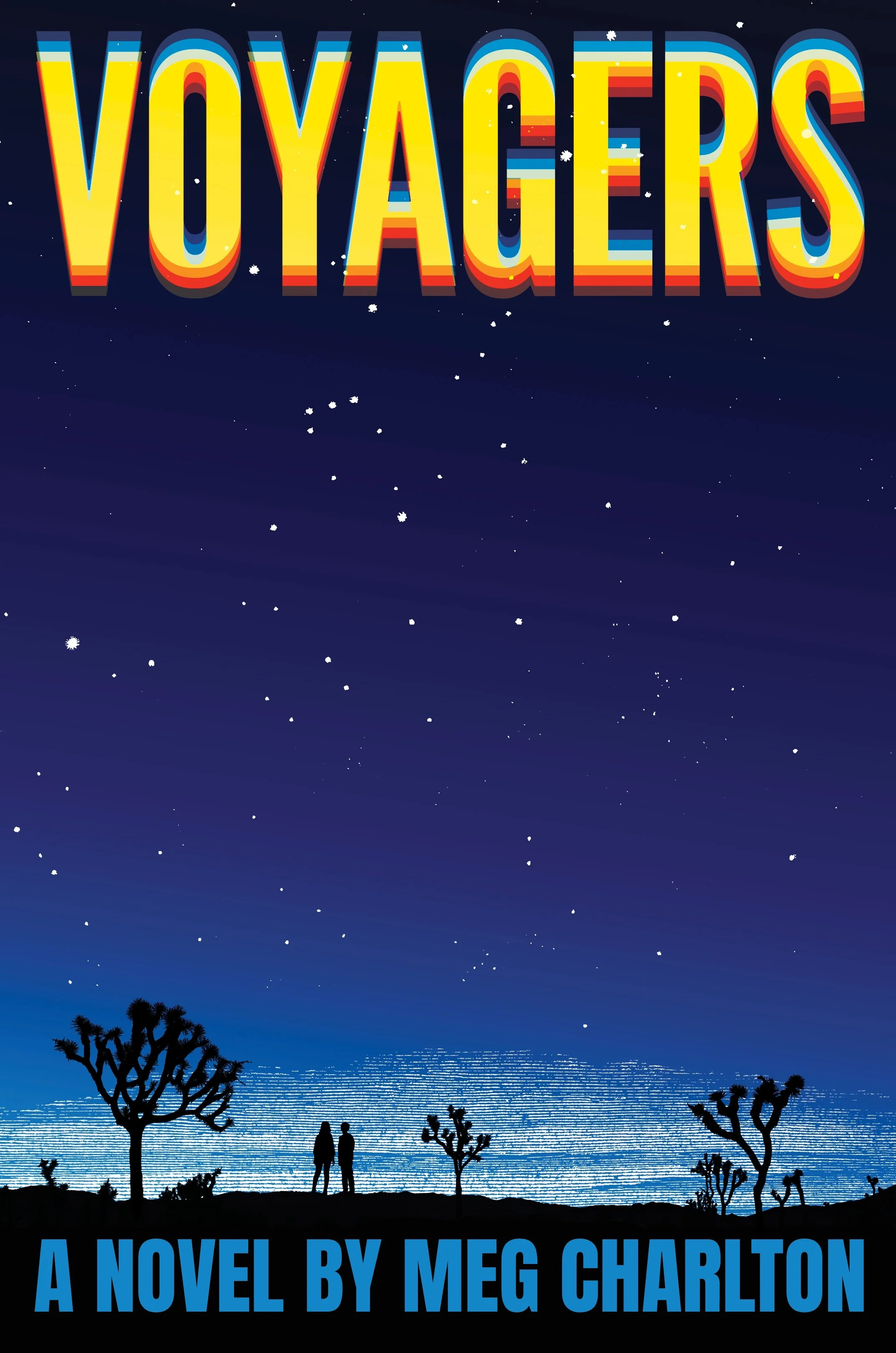
With the imaginative scope and propulsive storytelling of Station Eleven and The Ministry of Time, Voyagers is a thrillingly original and brilliantly ambitious literary debut about friendship at the end of the world.
Praise For Voyagers
"Charlton writes with such pristine propulsion and packs a punch on every page. This is going to be the book everyone loves and will be the talk of the town come summer." - Debutiful, "Most Anticipated"
"Charlton strikes just the right notes of smarts and warmth, and the result is an uncommonly confident debut novel. Readers who miss Mulder and Scully’s lighthearted side should dig in—but there’s satisfaction here for anyone." - Kirkus
"Charlton’s fascinating near-future debut puts a well-researched and deeply introspective spin on a familiar alien abduction scenario....This satisfying deep dive into the worlds of ufology and child stardom is sure to hook fans of first contact stories." - Publishers Weekly
"Charlton slides easily into flashbacks in between the scenes in the present, dovetailing Alex and Ana’s childhood relationship and their burgeoning adult one. The result is a novel that explores the strength and power of non-romantic love." - Booklist
"In the tradition of Gabrielle Zevin’s Tomorrow, and Tomorrow, and Tomorrow, Meg Charlton’s Voyagers is a finely written and propulsive novel about the enduring power of friendship. It takes on big issues: the reliability of memory, the price of childhood fame, the ways adults use children for their own purposes. It’s also a book about aliens, geared for terrestrials. Which is to say it’s complex and human, anchored by a beating heart.” - Joshua Henkin, author of Morningside Heights
"In Voyagers, Meg Charlton explores the connections between memory, storytelling, and truth. Against the backdrop of a global crisis, her characters contend with the lasting pain and confusion of a personal crisis. This novel grapples with the possibility of extraterrestrial life, but even more so with the possibility of friendship that is generous and forgiving. A delightful and moving debut." - Helen Phillips, author of Hum and The Need
"Voyagers is a tender sweeping epic about the quest for the self. Meg Charlton asks, in elegant and compelling prose: 'Can we escape the terrible events of our past or make of them what we will? And what happens to intimacy when we share a past but remember it differently?'. At its heart, Voyagers is a story about storytelling - how it tears us apart and might bring us back together again." - Taymour Soomro, author of Other Names for Love
A Conversation with Meg Charlton
author of VOYAGERS
(Harper; June 16, 2026)
Voyagers begins with a mysterious cosmic event, but quickly becomes an intimate story about friendship, family, and belief. What inspired you to write it?
I came up with the idea for Voyagers during a trip to Roswell in 2015. I was part of a documentary crew filming at the town’s annual UFO festival and found myself thinking about the trip long after the shoot was done. I think I was drawn to fictionalizing it because I knew the piece I’d been there filming couldn’t capture the full nuance and humanity of the stories we’d heard. The questions that those UFO experiences raised — about the reliability of memory, the nature of belief, and how much trust to put in stories, both the ones we tell ourselves and those we receive from the media or government — did not feel confined only to the world of ufology. Instead, they seemed like more extreme versions of ones we all grapple with. We all have memories, especially from childhood, that diverge from those of our parents or siblings or friends. We are all confronted, in ways large and small, with the choice of whether to trust our own version of events or someone else’s, to deem ourselves reliable witnesses to our own lives or not, to accept the stories others tell about us or to challenge them. The characters in Voyagers might be interrogating their memories of something extraordinary, but to me, their struggles are universal.
UFOs are taken seriously in Voyagers, which you use as an entry point into how we think about conspiracies and the consensus on reality. Can you talk about your interest in these themes and their relevance today?I’ve always been interested in how the stories we tell can become more real than the events that they describe and conspiracies are sort of the archetypal example of that. But theories about UFOs occupy, for me, an interesting place in that canon. To paraphrase David Wallace-Wells, most conspiracies are like a benzo — they calm you down, but they depress you—whereas belief in UFOs is like a psychedelic, offering “awe, wonder, a knee-wobblingly deep, mystical experience of existential ignorance.” I always loved that distillation and it felt like a beautiful space (no pun intended) to explore our culture’s attraction to conspiracies.
What kind of research did you conduct for the novel? What was the most interesting or surprising thing you learned?
After coming home from Roswell, my research was really a long, slow simmer. I found that the more I read, the more infinite the field of inquiry became, in a way that was both wonderful and overwhelming. Maybe because I was coming to this topic as an outsider to the world of ufology myself, I was drawn to books by other outsiders with a more academic bent, works such as John Mack’s Abduction, Diana Pasulka’s American Cosmic, and Susan Lepselter’s The Resonance of Unseen Things. But I also consumed a lot about conspiracy culture and paranoia—from Oliver Stone’s JFK to the Substack Getting Spooked—and about memory, both personal and collective. Finally, I spoke with a very generous aerospace engineer at NASA about how something like the satellite-disrupting signal picked up in the novel might actually work.
The most delightful thing I learned in my research was that Jimmy Carter saw a UFO and spoke quite openly about the experience. He did not think it was an alien spaceship, but he also allowed himself to sit with it as something truly unidentified. I was incredibly moved by that comfort with the unknown and it aligned with how I conceived of the novel as, in some ways, a conversion story about agnosticism. (Skeptics, in my experience, can be just as dogmatic as believers.) How could somebody learn to embrace not knowing, to accept their experience as, to quote John Mack, ‘a genuine mystery,’ to live with the fact that they might go their whole life without getting an answer? Those questions were at the heart of what I wanted to explore through Alex’s journey.
The friendship between Alex and Ana feels both timeless and specific—shaped by childhood fame, shared trauma, and the weight of myth. Did you draw from any literary or real friendships to get theirs so right?
Shocking as this may sound to those who’ve read the novel, in very early drafts of the book, Alex and Ana were actually twin siblings! But I realized that, in terms of narrative tension, there were limits to where that version of their bond could go. There’s a sense of constancy and obligation contained in sibling relationships, even the most volatile; I wanted Alex and Ana to choose their connection to each other, rather than inherit it as a fact of biology. Shifting Alex and Ana to friends completely unlocked the novel and allowed their relationship to come to its fullest, most complex form. I am sure that I drew some subconscious inspiration from friendships in my own life and from my relationship with different parts of myself — I have some Ana in me as much as I do Alex. (What can I say: I’m a Gemini.) But the three relationships I drew on most in literature were Lila and Lenú from Elena Ferrante’s Neapolitan novels, Kojima and “Eyes” in Mieko Kawakami’s Heaven, and, to return to my original conception of Alex and Ana as a sibling relationship, the titular brother and sister in J.D. Salinger’s Franny and Zooey.
Allen is an alien Alex and Ana dream up together. How does he function in their lives, as well as in the story itself?
Allen serves many functions and they change over the course of the story! He enters the novel as an inside joke between Alex and Ana, an imaginary alien friend they invented as children. His meaning, however, shifts as Alex and Ana grow up and Allen becomes a shibboleth of sorts, the ultimate symbol of their bond. But his meaning shifts for the reader, too. He functions both as comic relief and as way to question what is and isn’t real. Above all, though, Allen was just a joy for me to write. I loved inhabiting an alien consciousness, his in particular.
The arrival of the Signal introduces a tension that you sustain over the course of the novel. The plot stretches across decades, but feels immediate and utterly gripping. Did your background in television help you with pacing, or how did you approach this aspect of the book?
I’m glad it feels that way! I always loved Donna Tartt’s line that “the first duty of the novelist is to entertain.” I wanted this book to do that, to feel propulsive, and I absolutely drew on my time working in film and TV to do that. But more than anything, the professional experience that helped me the most with pacing was a brief stint in college freelancing headlines for The Onion. I was not much of a headline writer — my submissions rarely made it into the paper — but the experience forced me to distill my ideas to their tightest, purest form. Even if I failed as a comedian, I still draw on that training as a writer. I want to keep chipping away at any story or scene to find its final, most compelling form. I’m not always successful, but that’s the goal.
What do you hope readers take away from this story?
I hope they surprise me! I feel like I know this story inside and out, but I know new readers will find things in it that I never saw— and, in the end, that’s exactly what the book is about: The willingness to see our own story from a new perspective.